
A motorcycle crash can leave riders facing serious injuries, mounting medical bills, time away from work, and uncertainty about what comes next. The physical recovery is difficult enough. Understanding your rights and dealing with insurance companies can be just as frustrating.
Motorcycle accident claims in Michigan often involve issues that do not arise in other traffic cases. Questions about medical benefits, insurance coverage, fault, and compensation are not always straightforward, and the answers may depend on factors that most riders never have reason to think about until after a crash.
A Grand Rapids motorcycle accident lawyer can help identify available coverage, deal with insurance disputes, and pursue compensation for the full impact the accident has had on your life. For the full picture of Michigan's no-fault priority rules, helmet law, and fault analysis, see our Michigan motorcycle accident lawyers page.
Michigan's insurance system treats motorcycles differently than other vehicles, which can affect where benefits come from and what options are available after a collision. Below, we explain how those rules work, what happens when a motor vehicle is involved, and the additional challenges riders can face when it is not.
Call 1-855-NICOLET or contact us online for a free consultation. You do not pay attorney's fees unless we recover money for you.
Injured? Get Nicolet.
Grand Rapids Motorcycle Accident Statistics
Motorcycle crashes make up a small share of Kent County crashes but a large share of its serious injuries.
- Kent County recorded 192 motorcycle-involved crashes in 2024, including 6 fatal crashes, 150 injury crashes, and 172 people injured, on page 39 of the Michigan State Police 2024 annual crash report (county level).
- Kent County ranks third among Michigan's 83 counties for people killed or seriously injured in motorcycle crashes, with 301 over the five years from 2020 through 2024, in the Michigan Traffic Crash Facts county ranking (county level).
- Michigan recorded 3,187 motorcycle crashes, 168 motorcyclist deaths, and 2,460 motorcyclists injured in 2024, per page 16 of the Michigan Traffic Crash Facts 2024 fact sheets (state level). The 2024 to 2025 state comparison puts 2025 at 2,892 crashes and 151 deaths.
- Of the 168 motorcyclists killed in Michigan in 2024, 90 were wearing helmets, 64 were not, and helmet use was unknown for 14, in the helmet-use section of the Michigan Traffic Crash Facts fact sheets (state level).
- Kent County leads all Michigan counties in vehicle-deer crashes, with 2,097 in 2024, per the Michigan Traffic Crash Facts fact sheets and the Kent County profile (county level). A deer strike that dents a car can end a rider's season or worse, and single-vehicle deer crashes sit squarely in Michigan's required motorcycle coverage gap.
Behind each of these figures is a rider facing surgery, months off work, and an insurance company that may have already formed an opinion about how the crash happened. If a motorcycle crash in Grand Rapids has changed your daily life, a Grand Rapids motorcycle accident lawyer from Nicolet Law can investigate what happened, identify which insurer owes benefits, and pursue a claim that reflects the full impact of your injuries.
Which Insurance Company Pays a Michigan Rider's Medical Bills?

If a motor vehicle was involved, the statute names the order. Note that the rules acknowledge that the person driving the at-fault car may not be the car's owner.
MCL 500.3114(5) puts the insurer of the owner or registrant of the involved motor vehicle first, then the insurer of that vehicle's operator, then the auto insurer of the motorcycle's operator, then the auto insurer of the motorcycle's owner. Note the third and fourth positions: the statute reaches the rider's automobile policy, not the motorcycle policy.
| Crash situation | Source of no-fault medical benefits |
|---|---|
| Car turns left in front of a rider | The car owner's insurer first, under MCL 500.3114(5) |
| Rider struck by a commercial truck | The truck owner's insurer first, then the operator's |
| Hit and run by an unidentified vehicle | Possibly the Michigan Assigned Claims Plan, depending on eligibility under MCL 500.3172, capped at $250,000 |
| Single-bike crash on a county road | No PIP; health insurance and any first-party medical benefits purchased on the bike policy |
| Deer strike with no other vehicle | No PIP; same as above |
| Crash caused by a road defect only | No PIP; possible claim against the road agency, with a 120-day notice deadline |
When no motor vehicle was involved at all
If no motor vehicle was involved, there generally are no PIP benefits at all. MCL 500.3105 pays only for injury arising out of the use of a motor vehicle as a motor vehicle. That means a single-bike crash, a deer strike, a gravel spill, or a pothole ejection leaves the rider completely outside the no-fault system.
The coverage some Michigan riders do not know they can buy
Under MCL 500.3103, Michigan insurers writing motorcycle coverage must offer first-party medical benefits in $5,000 increments. That coverage is optional and has to be bought. It can provide a crucial source of coverage where no-fault benefits are unavailable.
What Does Michigan's Helmet Law Actually Require?
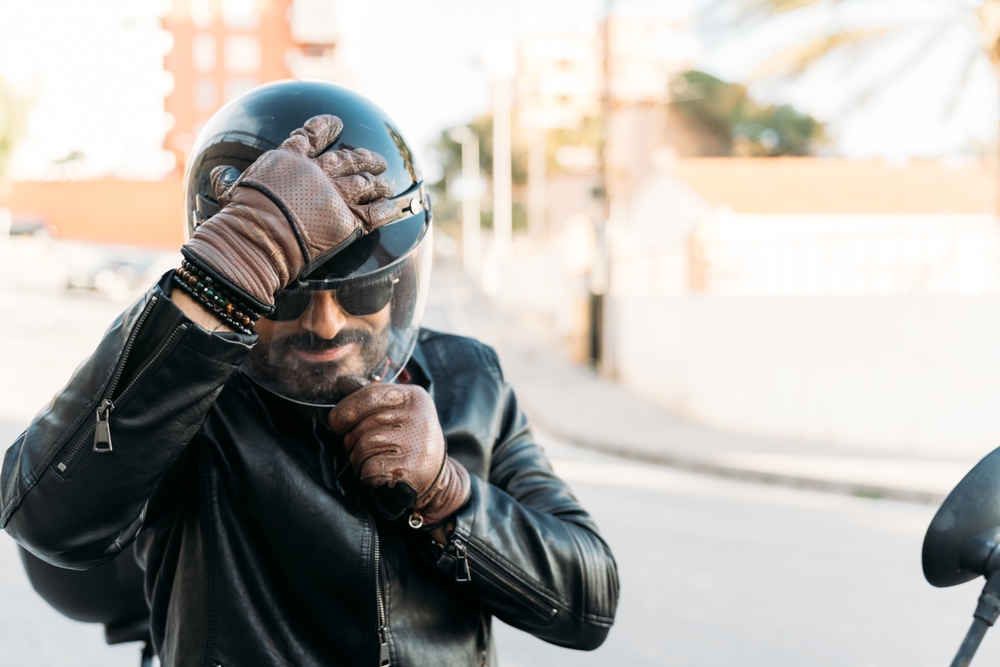
Helmets are required for some riders and optional for others, under certain conditions. MCL 257.658 lets an operator 21 or older ride without a helmet on two conditions:
- The rider has held a motorcycle endorsement for at least two years or finished an approved safety course
- They carry first-party medical benefits of at least $20,000
When a passenger 21 or older rides without a helmet, the coverage has to reach both people, at not less than $20,000 per person per occurrence. Riders under 21 must always wear a helmet.
No helmet does not mean no claim
Legally, the important point is what riding without a helmet does not mean. Where the statute permits it, it is not negligence in itself. Whether helmet use would have changed a particular injury is a comparative fault question under MCL 600.2959 that has to be proven with medical evidence. We make insurers carry that burden instead of conceding it.
Where Do Riders Have an Advantage in a Michigan Claim?
Economic damages can sometimes play a larger role in motorcycle cases. Riders often receive PIP benefits through another person's automobile policy, and the available coverage may be limited by that policy's selected PIP level. When medical expenses or wage loss exceed those benefits, the rider may pursue the excess from the at-fault driver.
In serious motorcycle crashes, those excess economic losses can be significant.
The threshold for pain and suffering does not change. MCL 500.3135 attaches to the defendant's use of a motor vehicle, so a rider suing a driver still has to show permanent serious disfigurement or a serious impairment of body function (or a loved one can show that a death occurred). Motorcycle accidents often involve severe injuries such as orthopedic injuries, hardware in a limb, and road rash scarring that can satisfy that threshold.
Michigan's comparative fault rule is also more forgiving than surrounding states. In Michigan, if a rider is found to be more than 50 percent at fault for their accident, they can still recover economic damages like medical bills and lost wages. They will be barred from recovering non-economic damages.
What Preventable Factors Turn Up in Most Rider Crashes?
The investigation often starts at the intersection, looking for factors such as:
Left-turn violations by drivers crossing a rider's path – one of the most common causes of motorcycle accidents.
Lane change violations – where a driver moved into a space a rider was already occupying, because a bike is a narrow profile in a mirror.
Following distance issues – since a bike needs less stopping room than the car behind it.
Road surface hazards – because gravel, a pavement edge, or a pothole that barely affects a car can put a rider down.
If insurers are pointing at each other while your bills go unpaid, we can sort out who owes what. Call 1-855-NICOLET or contact us online for a free consultation. You do not pay attorney's fees unless we recover money for you.
How Nicolet Law Deals With Insurance Assumptions About Riders
To put it simply, we place evidence in front of insurance adjusters before their bias sets in.
What the turning driver almost always reports
Adjusters open motorcycle files expecting speed and risk-taking, and the driver who turned left in front of a rider almost always says the bike came out of nowhere or that the rider was reckless. Left-turn and intersection crashes dominate motorcycle claims, and the physical evidence can tell a different story than what the driver claims happened.
How we establish what actually happened
We work to establish the rider's actual speed and line of travel using scene measurements, damage geometry, and where warranted, a reconstruction analysis. We can pull commercial video from businesses along the corridor before it is overwritten, which often happens within days.
What the file should say about the rider
We document endorsement status, safety course completion, and protective gear. We also handle communication with the insurer so you are not dealing with insurance questions when you should be focused on recovery.
There are a lot of moving parts in a motorcycle accident case, and Nicolet Law is ready to take over the legal process so you can focus on getting better.
Some of the crucial parts of a motorcycle accident case are the deadlines. Here's what to know about how Michigan handles filing deadlines:
- A suit against the at-fault driver generally must be filed within three years under MCL 600.5805(2)
- A suit for PIP benefits generally must be filed within one year under MCL 500.3145
- A road defect claim often comes with short notice requirements, including a 120-day notice requirement under MCL 691.1404
Exceptions exist for several of these periods. Because the shortest ones are measured in days, a rider is better served by calling early than by researching alone.
Nicolet Law has recovered more than $500,000,000 for clients. We are known to riders as The Midwest Motorcycle Lawyers, and the largest single result on our published case list came from a motorcycle case. We have former insurance insiders and registered medical professionals on staff, and every file is prepared as though it may be tried.
Talk with a Grand Rapids motorcycle accident lawyer at no cost. Call 1-855-NICOLET or contact us online. We work on a contingency fee, so you do not pay attorney's fees unless we recover money for you.
Injured? Get Nicolet.
FAQs About Grand Rapids Motorcycle Accident Lawyers
Should I add first-party medical coverage to my motorcycle policy?
That is an insurance decision rather than a legal one, and Michigan law requires insurers to offer it in $5,000 increments. Riders who carry it have a source of medical payment in exactly the crashes where no-fault benefits are unavailable.
Do I need my own auto insurance if I only ride?
It affects where you sit on the priority list. The third and fourth positions in MCL 500.3114(5) reach the rider's automobile policy, so a rider with no auto policy depends entirely on the involved vehicle's coverage. Riders without a car should understand that before a crash rather than after. Coverage depends on the existence of a valid applicable automobile policy and the specific facts of the claim.
My gear was destroyed. Can I recover for that?
Often yes, as property damage, and it is usually a small part of a claim. Helmets, jackets, boots, and electronics are legitimate losses. The gear also has evidentiary value showing impact points and severity, so we prefer to photograph and preserve it rather than have it discarded at the hospital.
Can a passenger on my bike bring a claim?
Usually, and passengers are typically in a strong position. Insurers still review everyone's conduct, including whether passenger movement affected the bike's balance and what the passenger knew about the ride beforehand. Those questions are normal in these files and easier to handle through a lawyer.
What if the driver who hit me says I was lane splitting?
That becomes a factual dispute rather than an automatic loss. Lane-splitting is illegal in Michigan, so the accusation carries weight and needs to be answered with evidence rather than argument. Scene position, damage patterns, and any available video can settle it.
Legal Resources About Michigan Motorcycle Accident Claims
Have more questions about motorcycle accidents? Below are attorney-curated resources that cover important topics and frequently asked questions from riders. While there is a lot of valuable information in the linked articles, they are not a substitute for advice on your specific claim.
- What to Do After a Motorcycle Accident: Step-by-Step Guide for Riders in the Midwest
- Fatal Motorcycle Accidents: Key Statistics, Legal Rights, and How to Protect Yourself
- How to Find a Motorcycle Accident Lawyer: 5 Qualities That Matter
- Top 5 Most Dangerous Roads for Motorcyclists in the Midwest
Every rider's coverage situation is different. If you were hurt riding in Grand Rapids, Michigan, call 1-855-NICOLET or contact Nicolet Law through our online contact form for a free case evaluation.